One-Step Flow Policy:Self-Distillation for Fast Visuomotor Policies

Shaolong Li

University of MichiganComputer Science and Engineering

Lichao Sun†

Lehigh University

Yongchao Chen†

Tsinghua UniversityCollege of AI

† Corresponding authors

Precise actions. Minimal latency.

High-fidelity control
in a single step.

OFP learns to generate action chunks through self-distillation from scratch, without a pre-trained teacher.

71.6%average success
across 56 simulated tasks
17.58 msgeneration time
per action chunk

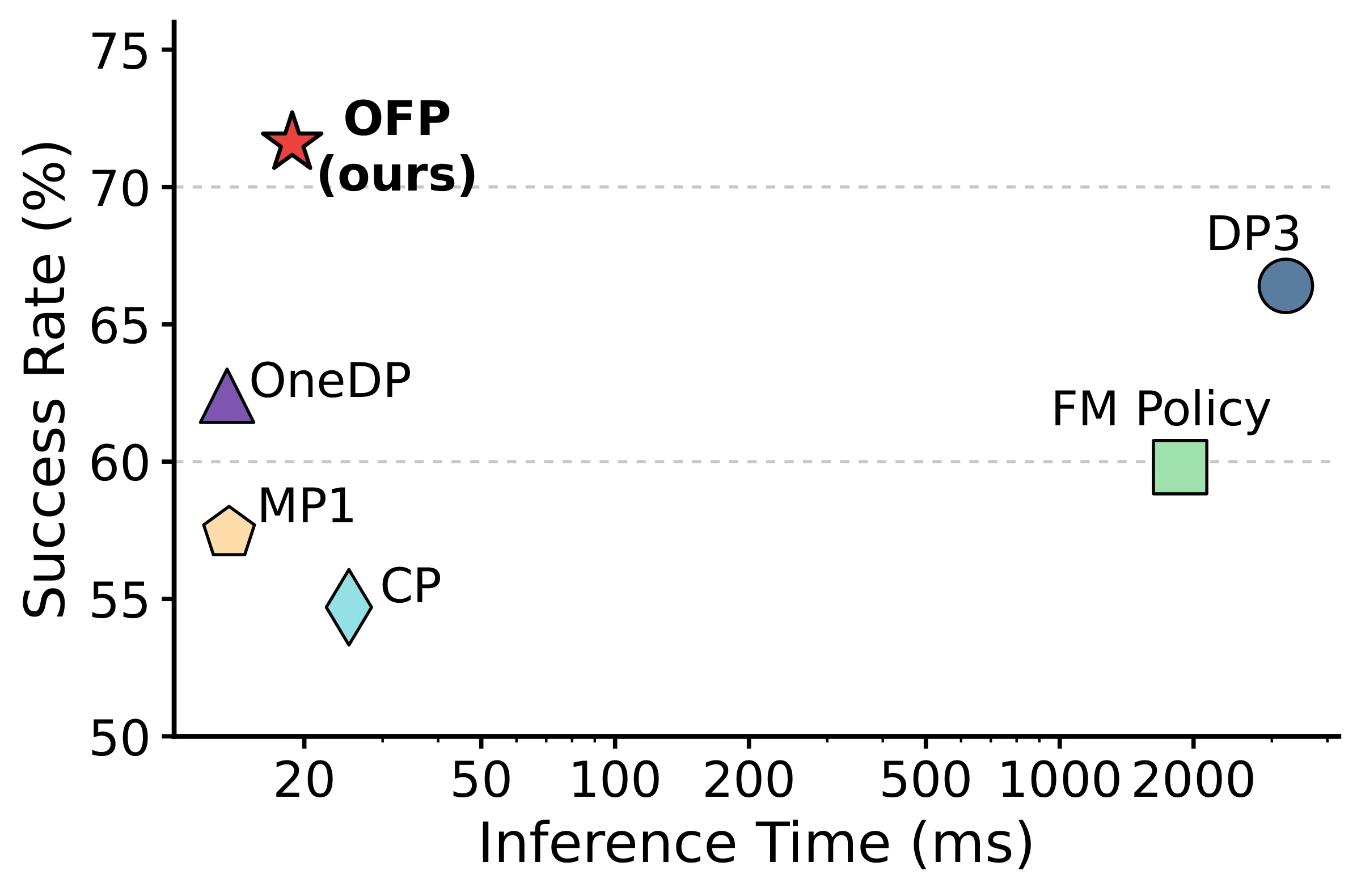
Over 100× faster action generation than 100-step DP3 and FM Policy.

Success rate versus inference time across 56 simulated tasks. OFP combines the highest average success rate with one-step inference.
Figure 1 Success rate vs. inference time. OFP attains the highest average success rate with one network evaluation (NFE = 1).

The idea in brief

Abstract

Generative flow and diffusion models provide the continuous, multimodal action distributions needed for high-precision robotic policies. However, their reliance on iterative sampling introduces severe inference latency, degrading control frequency and harming performance in time-sensitive manipulation. To address this problem, we propose the One-Step Flow Policy (OFP), a from-scratch self-distillation framework for high-fidelity, single-step action generation without a pre-trained teacher. OFP unifies a self-consistency loss to enforce coherent transport across time intervals, and a self-guided regularization to sharpen predictions toward high-density expert modes. In addition, a warm-start mechanism leverages temporal action correlations to minimize the generative transport distance. Evaluations across 56 diverse simulated manipulation tasks demonstrate that a one-step OFP achieves state-of-the-art results, outperforming 100-step diffusion and flow policies while accelerating action generation by over 100×. We further integrate OFP into the π0.5 model on RoboTwin 2.0, where one-step OFP surpasses the original 10-step policy. These results establish OFP as a practical, scalable solution for highly accurate and low-latency robot control.

01 / Method

Learning to get there in one step

Two complementary training signals turn iterative flow generation into precise, one-step action prediction.

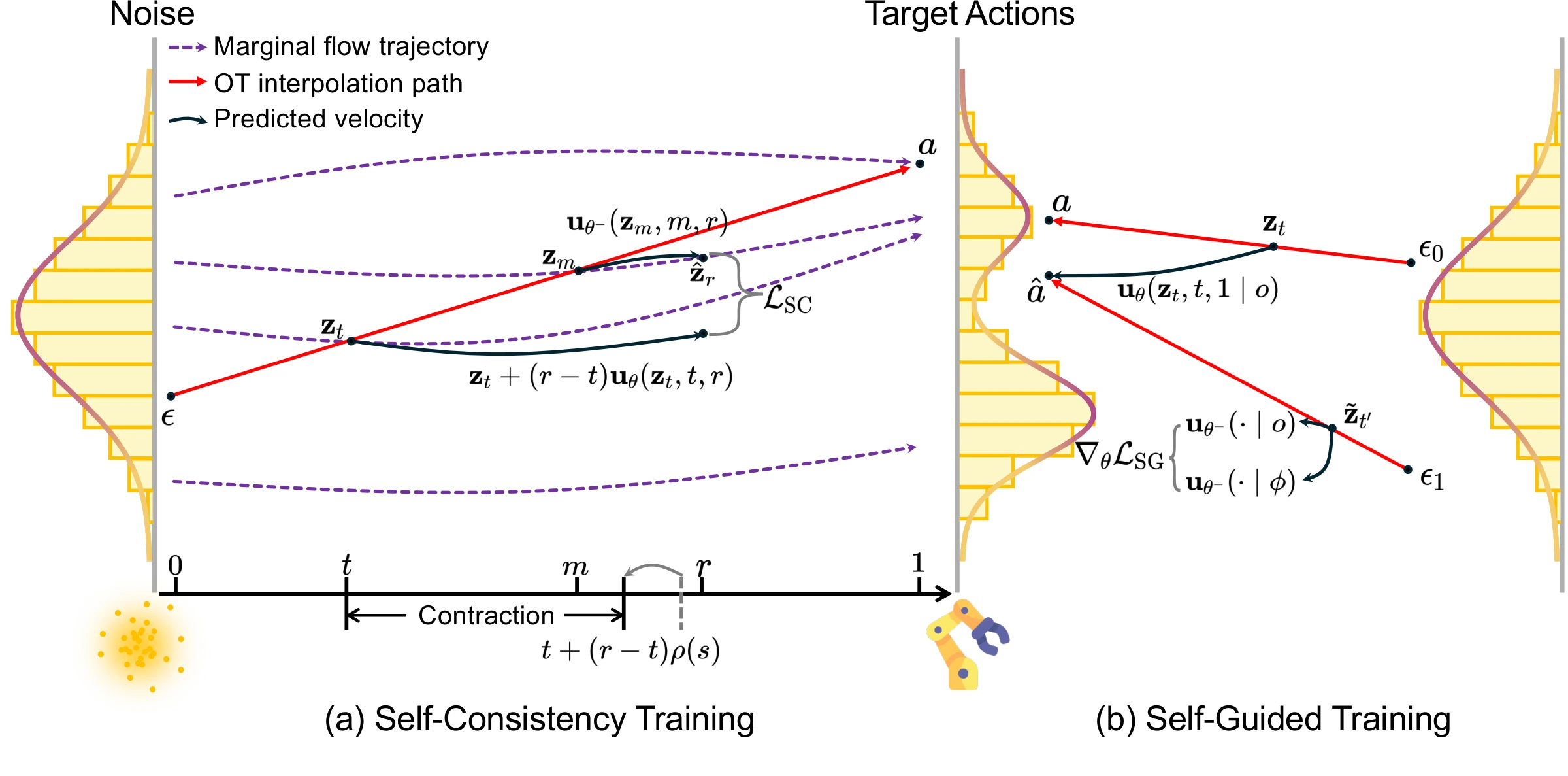
OFP self-distillation overview: self-consistency training matches interval-averaged velocities, while self-guided training sharpens action predictions.
Figure 2 The OFP self-distillation framework.
a

Self-consistency

Match interval-averaged velocities across nested time intervals. This teaches the policy to make a long transport step consistent with shorter ones.

b

Self-guidance

Use the model’s own conditional and unconditional predictions to sharpen generated actions toward high-density expert behaviors.

A better starting point

Reuse the plan.
Shorten the journey.

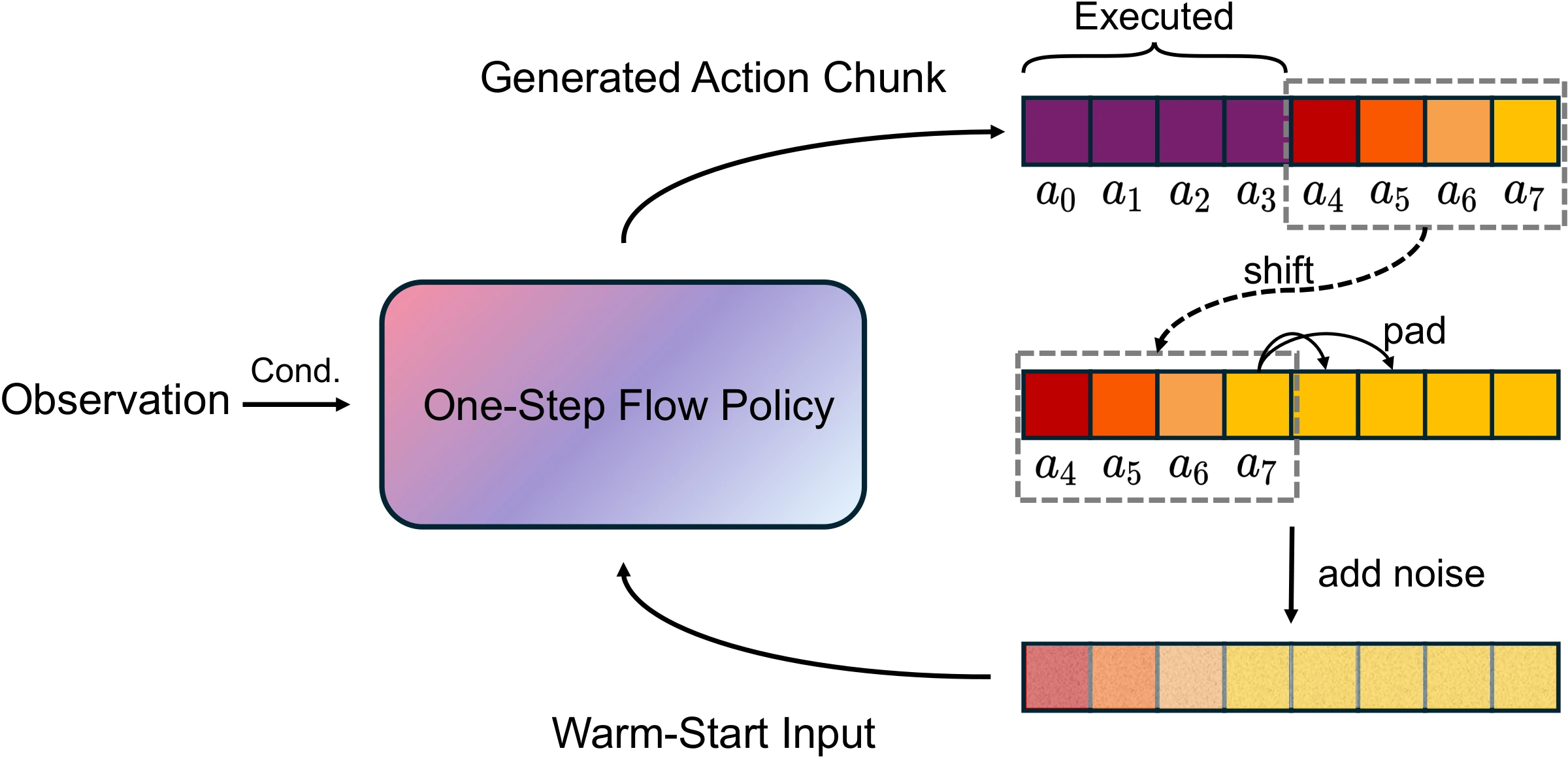
The next action chunk starts with useful information from the previous prediction. Shift its unexecuted suffix, pad the final action, and add noise to form a temporal prior.

This training-free warm-start reduces the transport distance needed for one-step generation.

Warm-start action generation: shift the unexecuted action suffix, pad with the terminal action, add noise, and condition the next prediction on a new observation.
Figure 3 Warm-start action reuse in receding-horizon control.

02 / Experiments

Fewer steps. Stronger results.

OFP improves average success in both image-conditioned and pointcloud-conditioned simulation benchmarks.

Table 1 / 2D observations

Image-based manipulation

With one generation step, OFP reaches 68.3% average success across seven Adroit and DexArt tasks, exceeding both 100-step baselines.

Table 1. Success rate in percent, mean ± standard deviation over three random seeds.
Method NFE Door Hammer Pen Bucket Faucet Laptop Toilet Average
DP100 51.7 ± 4.0 100.0 ± 0.0 67.7 ± 1.2 34.7 ± 4.7 38.7 ± 1.5 80.3 ± 2.9 76.0 ± 1.7 64.2 ± 2.3
DP10 44.7 ± 1.5 100.0 ± 0.0 66.7 ± 1.5 32.7 ± 4.0 35.0 ± 2.6 81.0 ± 2.6 66.0 ± 3.6 60.9 ± 2.3
FM Policy100 63.7 ± 2.1 100.0 ± 0.0 69.7 ± 2.1 31.7 ± 1.2 40.7 ± 2.3 84.7 ± 2.5 79.7 ± 1.5 67.2 ± 1.7
FM Policy10 61.3 ± 3.2 97.3 ± 3.1 64.7 ± 3.8 27.7 ± 2.3 32.7 ± 3.8 87.0 ± 1.7 77.3 ± 1.5 64.0 ± 2.8
CP1 46.3 ± 3.5 100.0 ± 0.0 58.7 ± 5.7 30.7 ± 2.5 33.3 ± 0.6 79.0 ± 2.6 69.7 ± 3.1 59.7 ± 2.6
OneDP1 53.3 ± 5.1 100.0 ± 0.0 64.7 ± 1.5 32.7 ± 1.2 40.0 ± 1.7 76.3 ± 2.9 76.3 ± 2.3 63.3 ± 2.1
MP11 49.3 ± 6.0 96.3 ± 3.5 57.3 ± 4.9 31.7 ± 6.7 33.0 ± 7.5 83.7 ± 1.5 72.3 ± 4.6 60.5 ± 5.0
OFP (Ours)1 68.3 ± 3.1 100.0 ± 0.0 69.3 ± 1.5 33.3 ± 2.5 41.0 ± 1.7 85.7 ± 3.5 80.7 ± 2.5 68.3 ± 2.1

Table 2 / 3D observations

Pointcloud-based manipulation

Across 56 tasks, OFP achieves 71.6% average success, compared with 66.4% for 100-step DP3 and 59.8% for 100-step FM Policy.

Table 2. Success rate in percent, mean ± standard deviation over three random seeds.
Method NFE Adroit3 tasks DexArt4 tasks MetaWorld Easy28 tasks MetaWorld Medium11 tasks MetaWorld Hard5 tasks MetaWorld Very Hard5 tasks Average
DP3100 79.0 ± 0.6 63.7 ± 0.6 82.8 ± 8.0 46.5 ± 3.8 38.3 ± 9.6 41.0 ± 0.6 66.4 ± 5.7
DP310 76.0 ± 3.3 61.5 ± 0.9 80.8 ± 2.1 46.2 ± 1.4 36.3 ± 8.2 45.3 ± 5.7 65.2 ± 2.8
FM Policy100 83.3 ± 0.7 61.7 ± 4.2 68.9 ± 5.7 42.3 ± 3.8 43.6 ± 3.4 47.7 ± 4.5 59.8 ± 4.6
FM Policy10 80.3 ± 1.8 60.5 ± 4.5 66.7 ± 7.7 41.3 ± 7.4 40.3 ± 7.2 46.7 ± 7.6 57.9 ± 7.0
CP1 76.3 ± 4.6 60.7 ± 3.4 68.3 ± 1.8 32.1 ± 4.3 28.7 ± 5.2 36.0 ± 2.3 54.7 ± 2.9
OneDP1 77.3 ± 1.8 62.5 ± 4.1 77.7 ± 0.5 39.6 ± 9.2 38.7 ± 4.4 41.7 ± 1.6 62.4 ± 3.0
MP11 82.0 ± 2.1 61.0 ± 2.0 70.5 ± 6.1 37.9 ± 5.9 34.3 ± 9.5 32.3 ± 5.5 57.4 ± 5.8
OFP (Ours)1 85.0 ± 4.5 64.3 ± 2.5 87.9 ± 4.6 52.4 ± 5.7 43.3 ± 2.4 49.2 ± 0.7 71.6 ± 4.1

Success rate (%), mean ± standard deviation over 3 random seeds. NFE: number of function evaluations. Highlighted cells mark the best results reported in the paper. Swipe tables horizontally to view all columns.

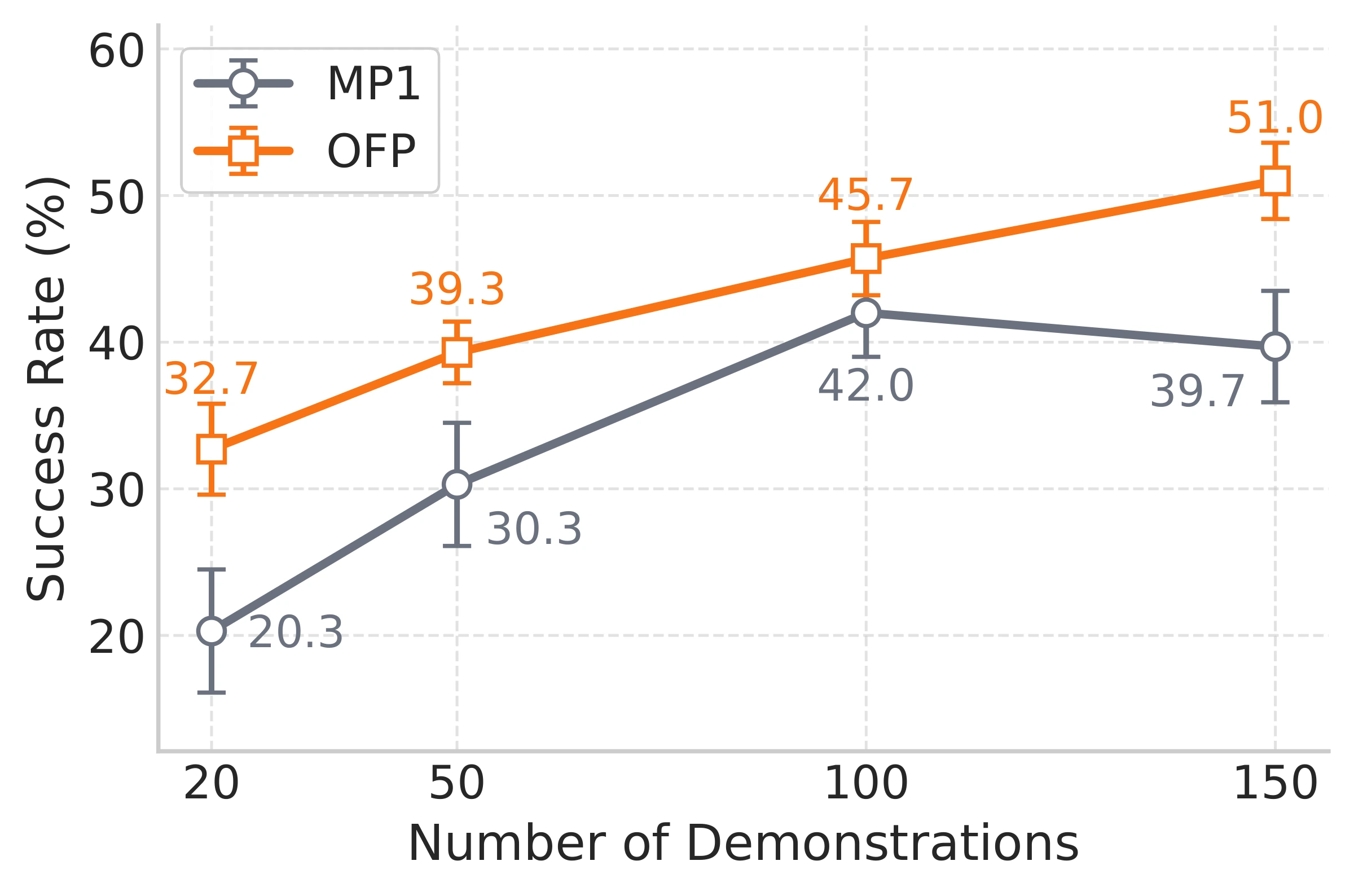
DexArt Faucet data scaling: OFP success rates are 32.7, 39.3, 45.7, and 51.0 percent with 20, 50, 100, and 150 demonstrations.
Figure 4 Data scaling on the DexArt Faucet task.

03 / Data efficiency

Effective with less.
Improving with more.

OFP achieves 32.7% success with just 20 demonstrations. Performance grows steadily to 51.0% with 150 demonstrations.

In this experiment, MP1 improves initially but drops at 150 demonstrations, while OFP continues to improve.

32.7% 51.0%20 to 150 demonstrations

04 / Scaling to VLA models

One step, even with π0.5

OFP integrates into a large vision-language-action model and retains its advantage on bimanual manipulation.

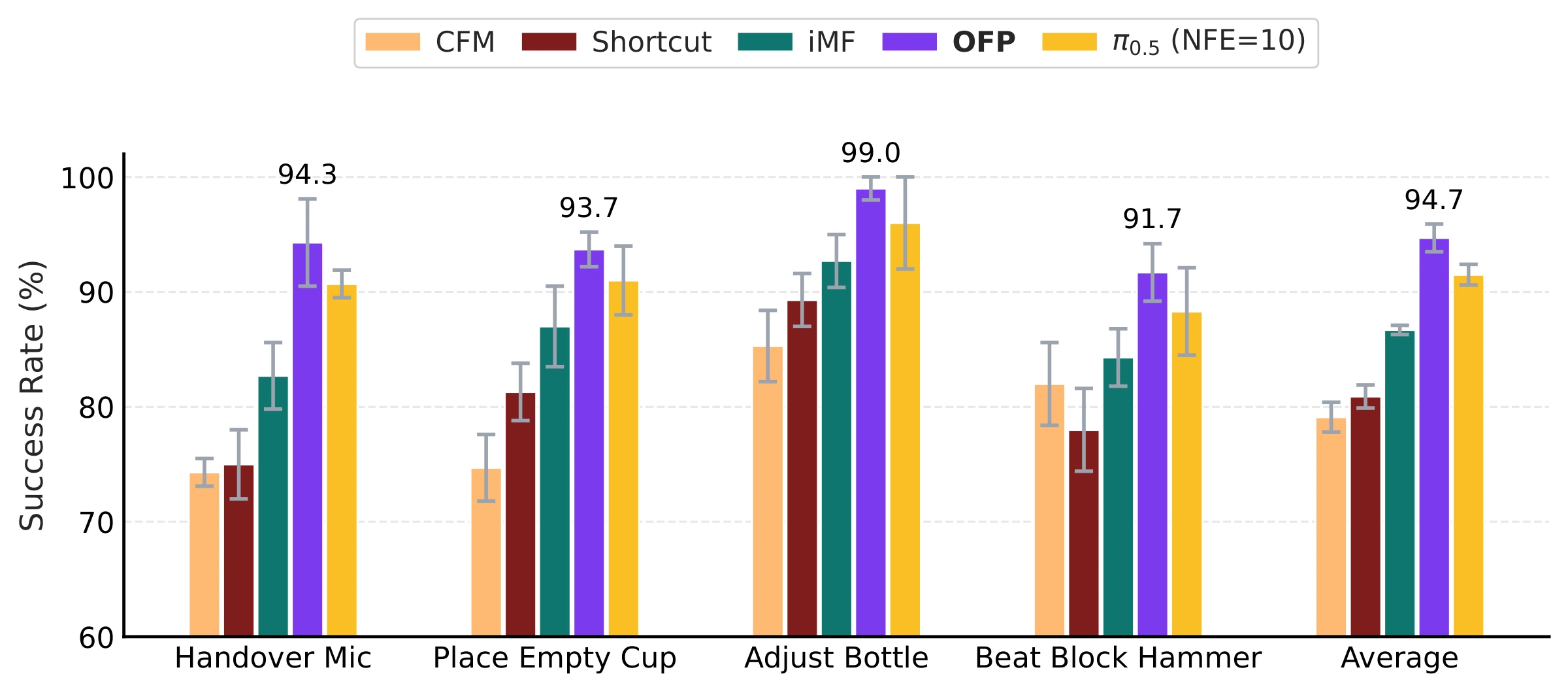
RoboTwin 2.0 integration with pi 0.5. OFP uses one generation step and achieves 94.7 percent average success across four tasks.
Figure 5 OFP reaches 94.7% average success across four RoboTwin 2.0 tasks. All acceleration methods use NFE = 1; the original π0.5 baseline uses NFE = 10. One-step OFP outperforms the original policy on each task.
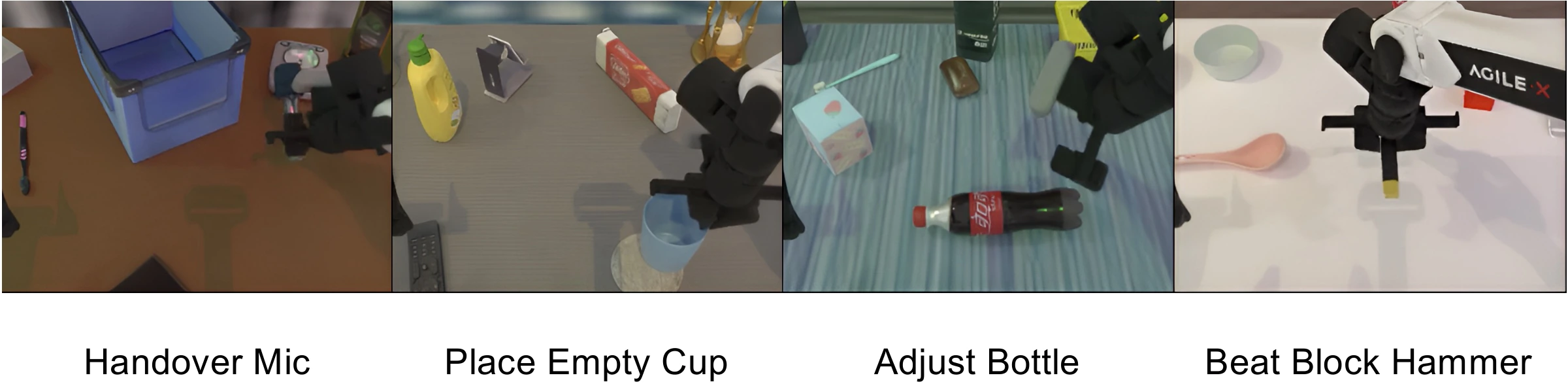
Four RoboTwin 2.0 simulation tasks: Handover Mic, Place Empty Cup, Adjust Bottle, and Beat Block Hammer.
Figure 6 The four evaluated RoboTwin 2.0 tasks. Domain randomization varies distractors, background textures, lighting, and tabletop height to test robustness under visual changes.

Reference

Citation

@inproceedings{li2026one,
  title={One-step flow policy: Self-distillation for fast visuomotor policies},
  author={Li, Shaolong and Sun, Lichao and Chen, Yongchao},
  booktitle={European Conference on Computer Vision},
  pages={22--39},
  year={2026},
  organization={Springer}
}

Figure

Original PDF ↗