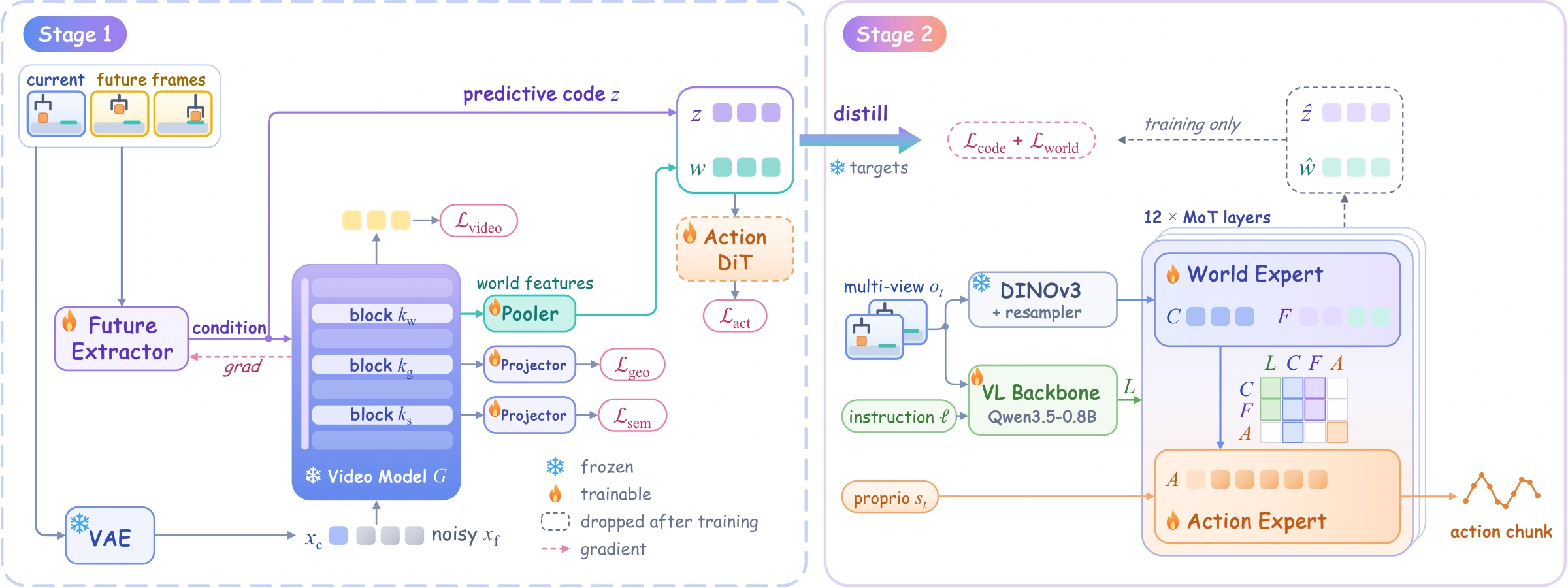
World action models (WAMs) typically adapt large pretrained video generators to jointly predict future observations and robot actions, incurring substantial training and deployment costs. However, it remains unclear which future representations a policy actually needs and how compactly they can be represented. Our probing study shows that complementary future representations can be compressed into a few tokens while retaining most of their action-decoding performance. Motivated by this finding, we introduce LeanWAM, a latent WAM that transfers video priors from a frozen video generator to a lightweight policy via two-stage training. In the first stage, a Future Extractor compresses observed transitions into 32 predictive tokens. These tokens condition the frozen generator and are jointly shaped by action, RGB, semantic, and geometric supervision, while a compact readout of the generator’s hidden states supplies complementary world tokens. The second stage distills both representations into the policy, which learns to predict them from current observations while generating actions. With 1.4B parameters and no large-scale embodied pretraining, LeanWAM outperforms strong vision-language-action (VLA) and WAM baselines on LIBERO, LIBERO-Plus, and RoboTwin 2.0. It predicts an action chunk in 25.1 ms on an A100 GPU, 12.3–41.5× faster than representative WAMs. These results demonstrate that compact predictive supervision can transfer video priors to robust and efficient control.
BibTeX
@unpublished{liLeanWAM,
  title = {{LeanWAM}: Learning Latent World Action Models from Frozen Video Models},
  author = {Li, Shaolong and Fu, Hongze and Chai, Joyce and Dai, Yinpei},
  note = {Preprint},
  url = {https://shaolonl-16.github.io/leanwam/}
}
02Preprint
MotionMEM: Self-Supervised Motion Tokens as Memory for Vision-Language-Action Policies
Hongze Fu*, Shaolong Li*, Byeongju Woo, Yinpei Dai, Yunhao Luo, Joyce Chai, and Nima Fazeli
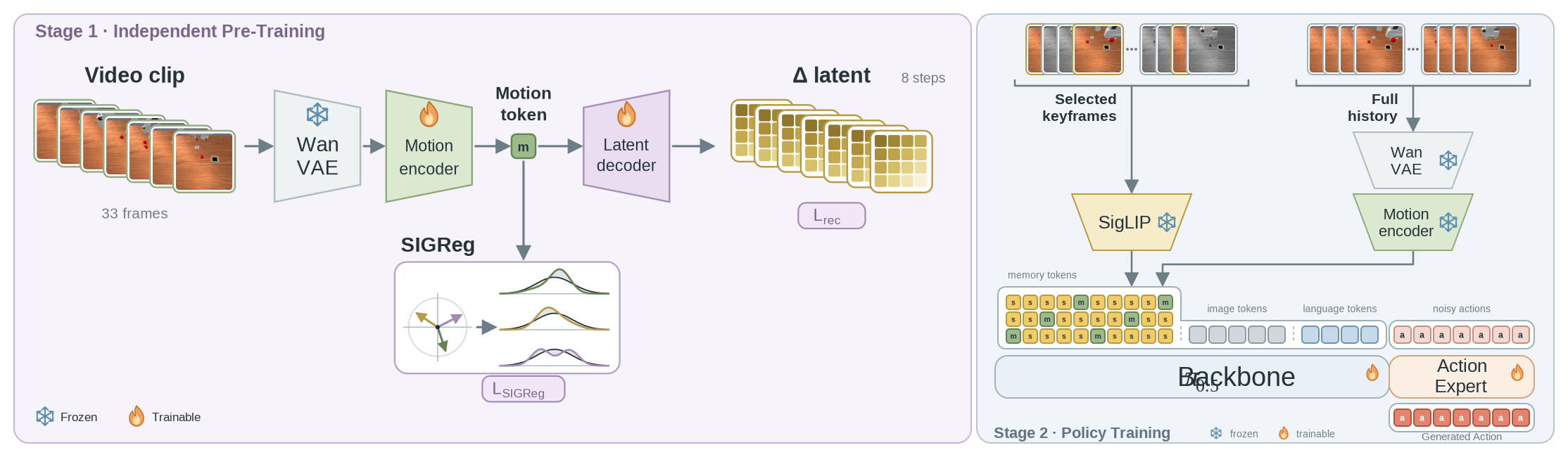
Vision-language-action (VLA) policies that need memory typically keep a sparse set of past frames. Such frames record what the scene looked like at the sampled instants but not how it changed between them. We ask how much extra memory a policy needs to recover what happened between frames, and find that very little suffices. We present MotionMEM, which adds a narrow motion channel beside the frame memory: a small self-supervised motion encoder, built on a frozen video VAE, compresses each 33-frame window into a single token. On RoboMME, adding at most 96 motion tokens to 512 frame tokens raises average success from 30.7% to 37.3%, with only 13.9 motion tokens used per episode on average. Pooling frozen video latents into one token at the same budget reaches 35.5% and falls 8 to 19 points behind on tasks that depend on the order of events, so the compression itself must be learned. The learned tokens are also inspectable: linear probes decode task progress from the policy’s hidden states more accurately than under frame-only memory.
BibTeX
@unpublished{fuMotionMEM,
  title = {{MotionMEM}: Self-Supervised Motion Tokens as Memory for Vision-Language-Action Policies},
  author = {Fu, Hongze and Li, Shaolong and Woo, Byeongju and Dai, Yinpei and Luo, Yunhao and Chai, Joyce and Fazeli, Nima},
  note = {Preprint}
}
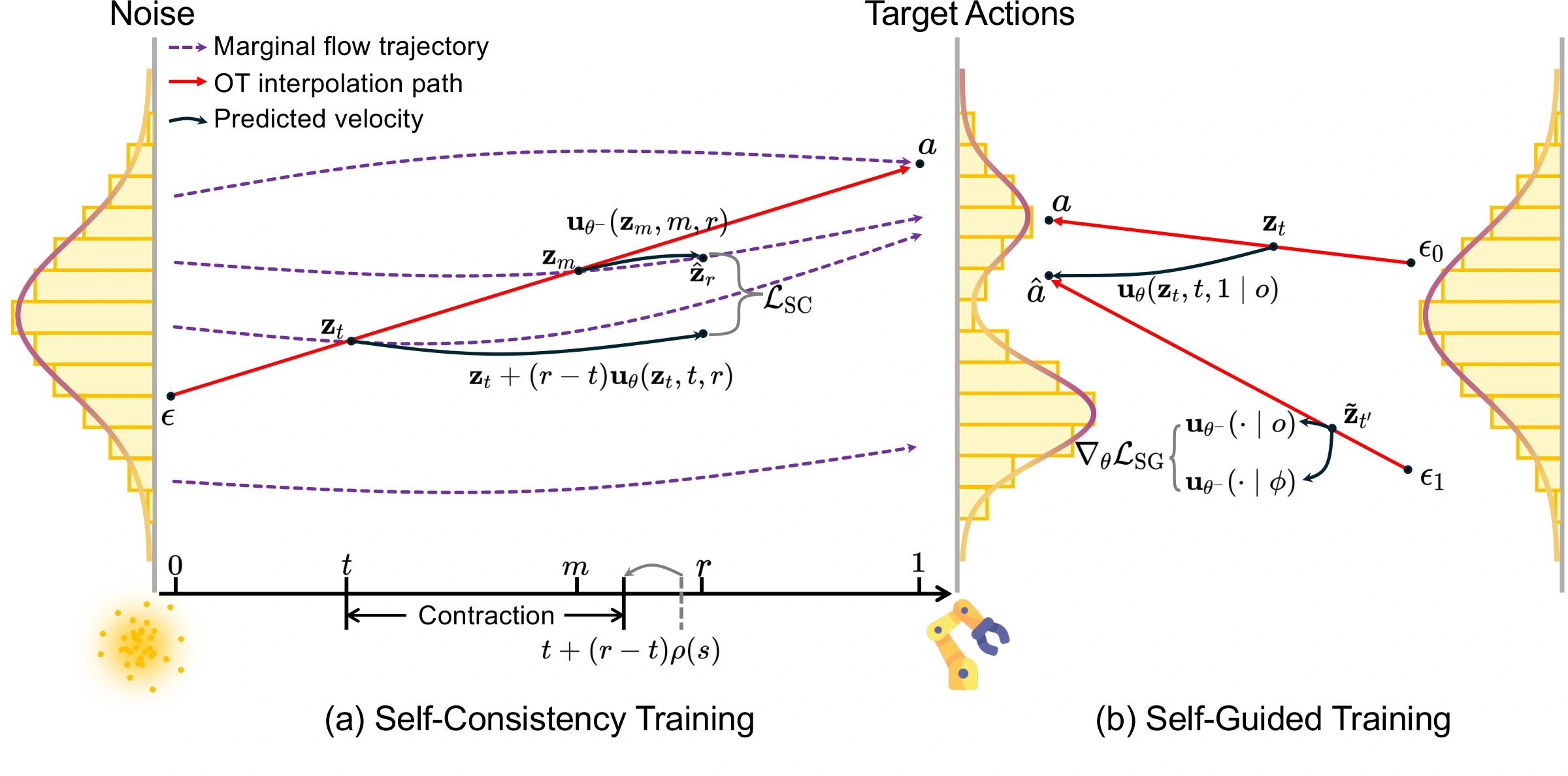
Generative flow and diffusion models provide the continuous, multimodal action distributions needed for high-precision robotic policies. However, their reliance on iterative sampling introduces severe inference latency, degrading control frequency and harming performance in time-sensitive manipulation. To address this problem, we propose the One-Step Flow Policy (OFP), a from-scratch self-distillation framework for high-fidelity, single-step action generation without a pre-trained teacher. OFP unifies a self-consistency loss to enforce coherent transport across time intervals, and a self-guided regularization to sharpen predictions toward high-density expert modes. In addition, a warm-start mechanism leverages temporal action correlations to minimize the generative transport distance. Evaluations across 56 diverse simulated manipulation tasks demonstrate that a one-step OFP achieves state-of-the-art results, outperforming 100-step diffusion and flow policies while accelerating action generation by over 100×. We further integrate OFP into the π0.5 model on RoboTwin 2.0, where one-step OFP surpasses the original 10-step policy. These results establish OFP as a practical, scalable solution for highly accurate and low-latency robot control.
BibTeX
@inproceedings{li2026one,
  title={One-step flow policy: Self-distillation for fast visuomotor policies},
  author={Li, Shaolong and Sun, Lichao and Chen, Yongchao},
  booktitle={European Conference on Computer Vision},
  pages={22--39},
  year={2026},
  organization={Springer}
}
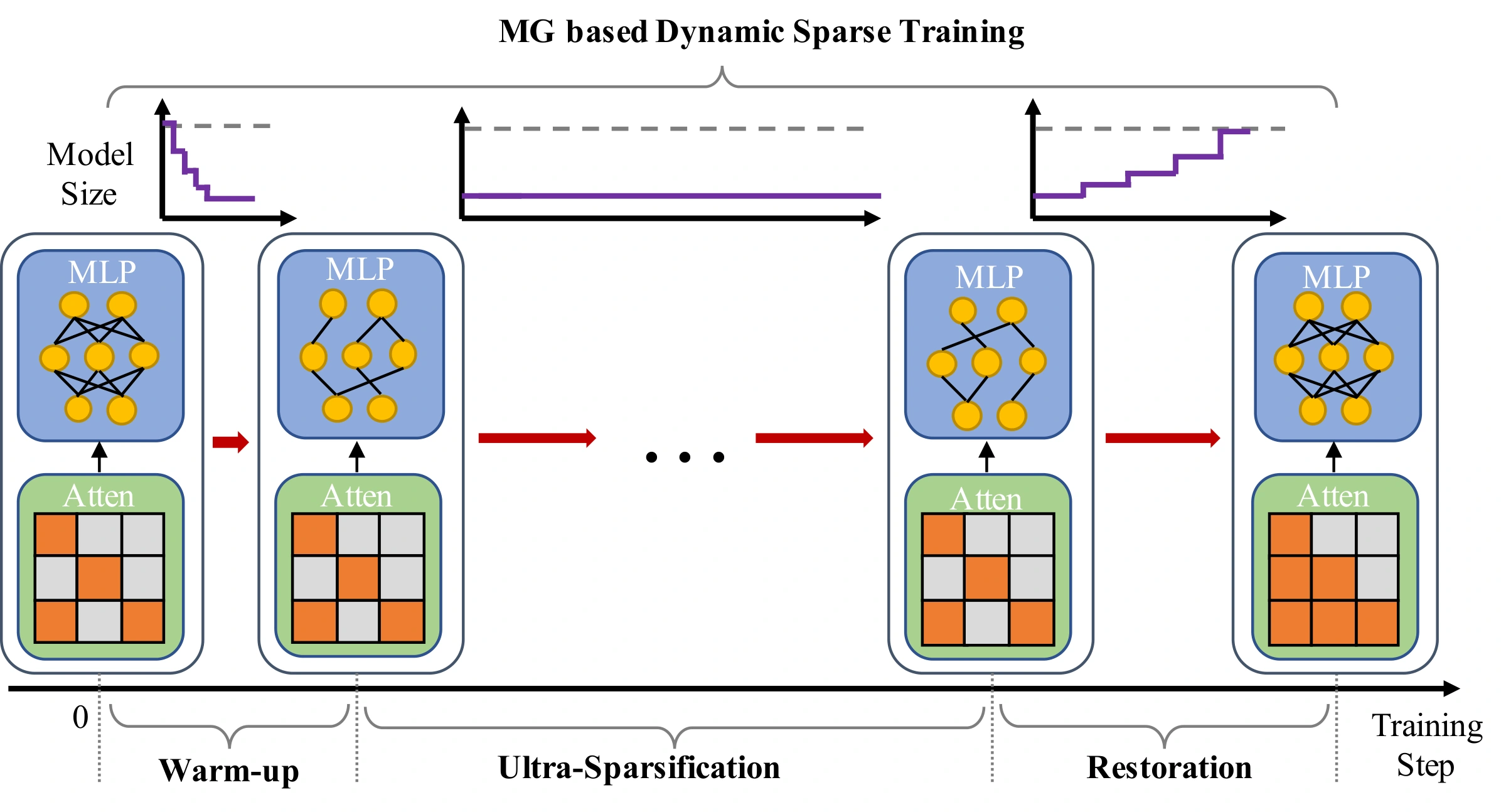
Large language models (LLMs) have made significant strides in complex tasks, yet their widespread adoption is impeded by substantial computational demands. With hundreds of billion parameters, transformer-based LLMs necessitate months of pretraining across a high-end GPU cluster. However, this paper reveals a compelling finding: transformers exhibit considerable redundancy in pretraining computations, which motivates our proposed solution, Mixed Sparsity Training (MST), an efficient pretraining method that can reduce about 75% of Floating Point Operations (FLOPs) while maintaining performance. MST integrates dynamic sparse training (DST) with Sparsity Variation (SV) and Hybrid Sparse Attention (HSA) during pretraining, involving three distinct phases: warm-up, ultra-sparsification, and restoration. The warm-up phase transforms the dense model into a sparse one, and the restoration phase reinstates connections. Throughout these phases, the model is trained with a dynamically evolving sparse topology and an HSA mechanism to maintain performance and minimize training FLOPs concurrently. Our experiment on GPT-2 showcases a FLOP reduction of 4× without compromising performance.
BibTeX
@article{hu2025mixed,
  title = {Mixed Sparsity Training: Achieving 4$\times$ {FLOP} Reduction for Transformer Pretraining},
  author = {Hu, Pihe and Li, Shaolong and Wang, Xun and Huang, Longbo},
  journal = {Transactions on Machine Learning Research},
  year = {2025},
  url = {https://openreview.net/forum?id=XosdLS7KVE}
}
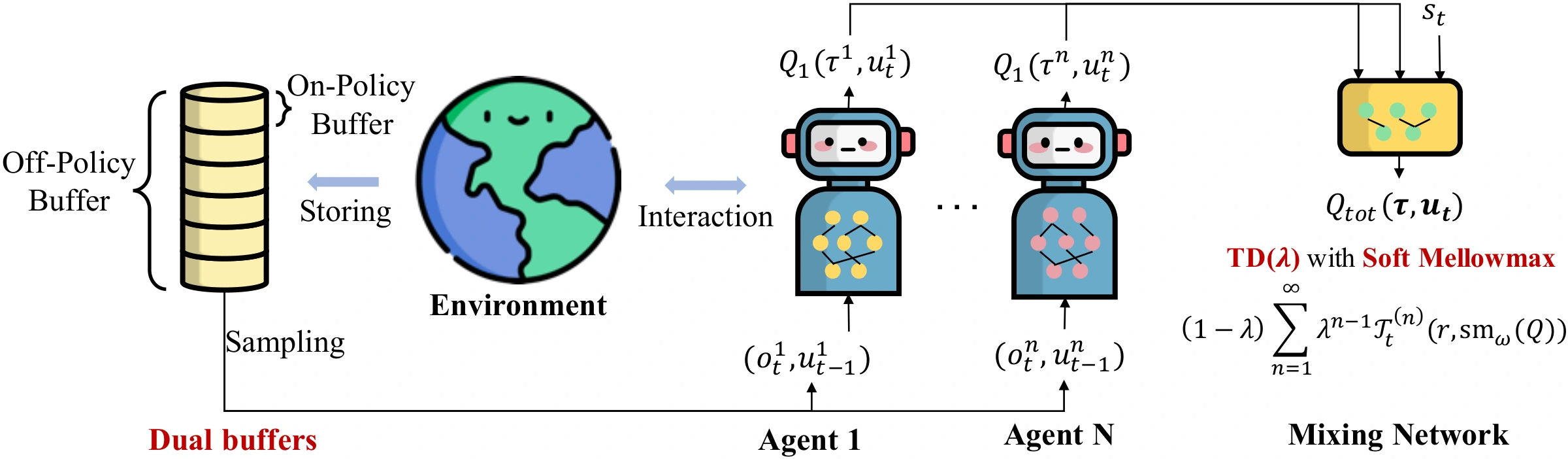
Deep Multi-agent Reinforcement Learning (MARL) relies on neural networks with numerous parameters in multi-agent scenarios, often incurring substantial computational overhead. Consequently, there is an urgent need to expedite training and enable model compression in MARL. This paper proposes the utilization of dynamic sparse training (DST), a technique proven effective in deep supervised learning tasks, to alleviate the computational burdens in MARL training. However, a direct adoption of DST fails to yield satisfactory MARL agents, leading to breakdowns in value learning within deep sparse value-based MARL models. Motivated by this challenge, we introduce an innovative Multi-Agent Sparse Training (MAST) framework aimed at simultaneously enhancing the reliability of learning targets and the rationality of sample distribution to improve value learning in sparse models. Specifically, MAST incorporates the Soft Mellowmax Operator with a hybrid TD-(λ) schema to establish dependable learning targets. Additionally, it employs a dual replay buffer mechanism to enhance the distribution of training samples. Building upon these aspects, MAST utilizes gradient-based topology evolution to exclusively train multiple MARL agents using sparse networks. Our comprehensive experimental investigation across various value-based MARL algorithms on multiple benchmarks demonstrates, for the first time, significant reductions in redundancy of up to 20× in Floating Point Operations (FLOPs) for both training and inference, with less than 3% performance degradation.
BibTeX
@inproceedings{NEURIPS2024_31888563,
 author = {Hu, Pihe and Li, Shaolong and Li, Zhuoran and Pan, Ling and Huang, Longbo},
 booktitle = {Advances in Neural Information Processing Systems},
 doi = {10.52202/079017-0883},
 editor = {A. Globerson and L. Mackey and D. Belgrave and A. Fan and U. Paquet and J. Tomczak and C. Zhang},
 pages = {28150--28190},
 publisher = {Curran Associates, Inc.},
 title = {Value-Based Deep Multi-Agent Reinforcement Learning with Dynamic Sparse Training},
 url = {https://proceedings.neurips.cc/paper_files/paper/2024/file/31888563b194f9bb33ce1aebc7e1551c-Paper-Conference.pdf},
 volume = {37},
 year = {2024}
}